
Renal Stones
- Home
- Services
- Featured Treatment
- Renal Stones
Renal Stones
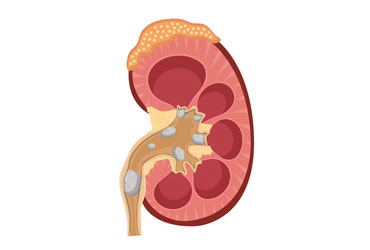
Kidney stones are sometimes called renal calculi. The condition of having kidney stones is termed nephrolithiasis.It is a solid concretion or crystal aggregation formed in the kidneys from dietary minerals in the urine. Urinary stones are typically classified by their location in the kidney (nephrolithiasis), ureter (ureterolithiasis), or bladder (cystolithiasis), or by their chemical composition (calcium-containing, struvite, uric acid, or other compounds).
This is one of the commonest causes for pain in abdomen. It can also cause infection & obstruction to the follow of urine. Stones are first formed in the kidney and then they pass towards the bladder. Small stones may be passed with out giving rise to any problems. But large stones are ones which cause problem. Kidney stones are more common is middle age people than the elderly.
Cause
Dietary factors that increase the risk of stone formation include low fluid intake, and high dietary intake of animal protein, sodium, refined sugars, oxalate, grapefruit juice, apple juice, and cola drinks.
Hereditary. It may run in the family. Chronic urinary tract infection in one of the major cause for stone formation. Decrease in fluid intake may cause formation of stones. Increase calcium intake i.e. more than the required amount (e.g. intake of too much of chocolates, strawberries). Prolonged bed ridden patients may have stone formation.
Increase in uric acid level, in the body. Hot weather leads to increase fluid out put thus less fluid in body and thus in formation of stones.
SIGN & SYMPTOMS
Excruciating intermittent pain that radiates from the flank to the groin or to the genital area and inner thigh. This particular type of pain, known as renal colic, is often described as one of the strongest pain sensations known.
1. Painful urination.
2. Red urine.
3. Nausea & Vomiting.
4. Profuse sweating.
In case of an infection along with the above mentioned symptoms there may be Fever with Chills. Frequent urge to pass urine.
DO'S AND DON'TS
- Increasing fluid intake citrate-rich fluids (especially citrate-rich fluids such as lemonade and orange juice), with the objective of increasing urine output to more than 2 liters per day.
- Attempt to maintain a calcium (Ca) intake of 1000 – 1200 mg per day.
- Limiting sodium (Na) intake to less than 2300 mg per day.
- Limiting vitamin C intake to less than 1000 mg per day (A positive association between animal protein consumption and recurrence of kidney stones has been shown in men, but not yet in women.)
- Limiting animal protein intake to no more than 2 meals daily, with less than 170 – 230 gram per day.
- Limiting consumption of foods containing high amounts of oxalate (such as spinach, strawberries, nuts, rhubarb, wheat germ, dark chocolate, cocoa, brewed tea)
- Never let yourself become dehydrated. Drink 3-5 litres of water if you are suspected of having a stone. Or if you are doing strenuous work, in a hot humid climate.
- Avoid milk & milk products because they are rich in calcium Also avoid chocolate, beans, beets.
- Avoid red meat which causes uric acid levels to increase.
- Avoid Egg, meat, fish – Crystal stones.
- Avoid Calcium containing pain killers.
- Increase fiber i.e. bran.
- Beer is good for flushing out the stone – but do not over indulge.
- Barley water helps is removing stones.
- Never self-medicate.